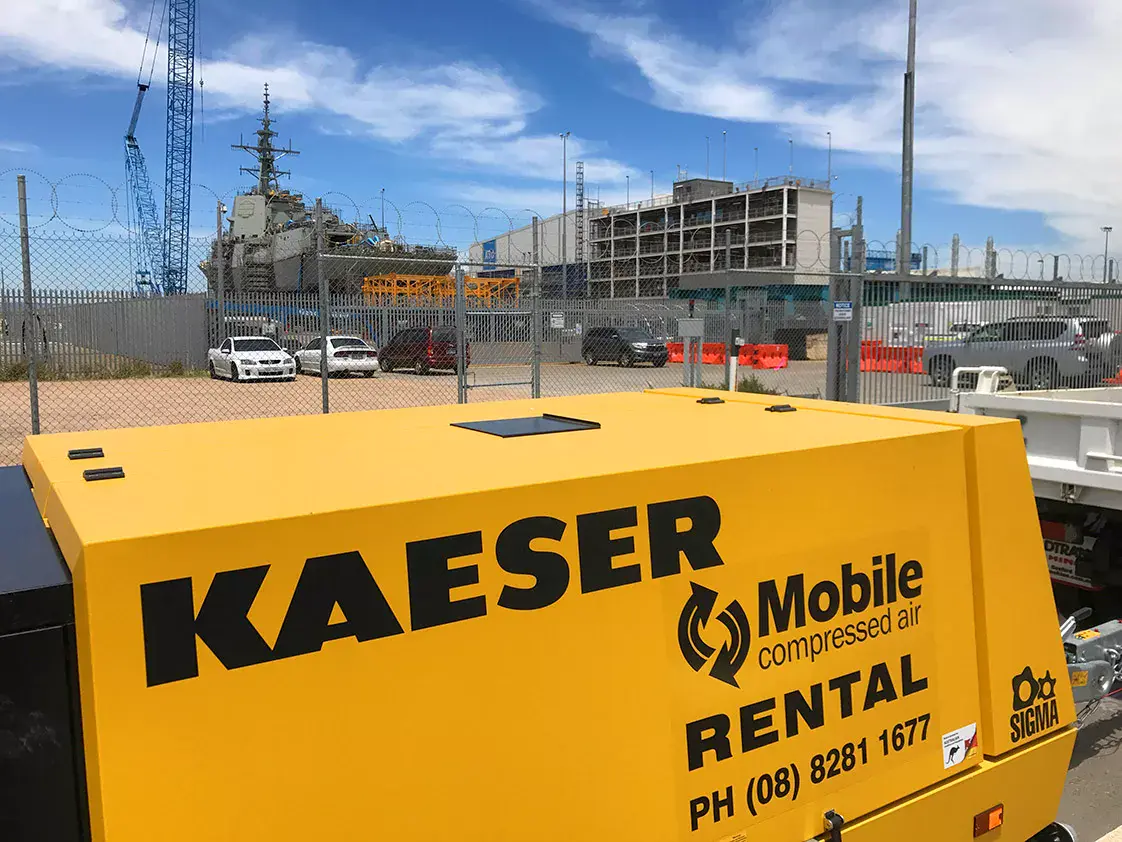
Well-Planned Installation
Getting your air compressor installation right is one of the most important decisions you’ll make for your compressed air system. Proper installation affects energy use, equipment life, air quality, safety, and the day-to-day reliability of every tool and process that depends on compressed air downstream. A well-planned installation runs quietly, uses less power, and lasts years longer than a poorly set-up unit.
At Mobile Compressed Air, we design, install, commission, and service permanent compressed air systems across South Australia and the Northern Territory. As the authorised Kaeser Compressors distributor for SA and with nearly 40 years of field experience, we treat installation as an engineered process, Air compressor installation is not simply a delivery, but a fully integrated solution with ongoing support.


Why Proper Air Compressor Installation Matters
A correctly installed air compressor delivers the pressure and air quality your operation needs, with minimal waste. A poorly installed one causes problems that often don’t show up until months later: reduced efficiency, increased energy consumption, premature equipment failure, pressure drops at the point of use, and compromised air quality from moisture, dust, or oil carryover.
The factors that separate a good installation from a bad one are all practical: the right location, a suitable power supply, properly sized piping, clean intake air, effective heat dissipation, and easy access for servicing. Ensuring these are addressed from the outset is significantly more cost-effective than rectifying them later.
Planning the Installation Site
Before any equipment is delivered or installed, we assess the installation site with you. This visit covers duty, pressure, air quality requirements, power supply, site access, noise constraints, and timeline. The answers here shape every decision that follows.
Location
The installation location should be dry, clean, and as cool as practical. Compressors draw in ambient air, so a dusty or humid location means contaminants reach the air intake filter and, eventually, your tools and equipment. Avoid areas near grinding operations, loading docks, or anywhere with high airborne debris, and position the unit to prevent dust settling on or near the intake.
Ventilation and heat dissipation
Air compressors generate heat. Without proper ventilation, internal components run at higher operating temperatures than they’re designed for, which accelerates wear and shortens service life. The installation space needs enough airflow to carry heat away from the unit, with clearances around the machine so cooling fans can draw in fresh air and exhaust warm air out of the room. Additionally, if the air compressor is poorly sized for it’s operations, there is a chance that it will continuously overheat and worsen the lifespan of your compressor.
For larger industrial air compressors, ducted ventilation or dedicated cooling arrangements are often required. Where multiple compressors share a plant room, the combined heat load has to be designed for, not assumed.
Enough space and floor strength
Every installation needs enough space for the compressor itself, its accessories (receiver tank, dryer, filters, pressure regulator), and safe clearance for technicians to work. Installations that appear neat and compact initially can become difficult to service when components such as valves or belts require maintenance or replacement.
A practical guideline is that a technician should be able to comfortably access all sides of the compressor with the necessary tools. If this is not achievable, the installation is likely too constrained. Adequate access is essential to ensure routine maintenance can be carried out efficiently and without unnecessary cost. The weight of the unit also matters. A large industrial air compressor and full receiver tank can run to several tonnes, so the slab or floor needs to be rated to carry it without flexing or cracking.
Noise levels
Industrial compressors produce noise. Modern rotary screw units run far quieter than older piston designs, but even a machine in the 65 to 75 dB range needs thought about where it sits in relation to workstations and offices. Acoustic enclosures, vibration isolation pads, and separate plant rooms are all options we can work through with you to maintain a safe working environment that meets WHS requirements.


Our Installation Service
Power Supply and Electrical Requirements
An air compressor needs a suitable power supply matched to its motor size and starting current. Undersized wiring, shared circuits, or inadequate electrical outlets lead to voltage drops, nuisance tripping, and motor damage.
Most industrial air compressors require a dedicated circuit sized for the motor’s full-load amperage plus start-up inrush. Single-phase units suit smaller workshops. Three-phase is standard for anything of meaningful industrial capacity. Before installation, we confirm the site’s electrical capacity, coordinate with your site coordinators, and make sure the power supply is ready on the day the compressor arrives.
Piping System Design
The piping system that carries compressed air from the compressor to the point of use is where a lot of systems lose performance. Undersized piping, sharp bends, poor layout, and air leaks can waste 20 to 30 per cent of the compressed air you’ve paid to produce.
Good piping design covers:
- Correct pipe diameter for the required air flow and allowable pressure drop
- Smooth routing with minimal bends and fittings
- Properly sloped lines with drain points to remove condensate
- Isolation valves at zones and drops for maintenance
- Quality fittings that won’t develop leaks under cycling pressure
- Flexible air hose connections at tools, sized so they don’t choke flow
A well-designed piping system delivers full pressure and clean air to every outlet, without forcing the compressor to work harder than it should.
Air Quality: Filters, Dryers, and Receivers
Compressed air straight out of the compressor contains water, oil mist, and particulates. For most applications, that’s not good enough. The right combination of a receiver tank, refrigerated or desiccant dryer, and inline filters removes these contaminants and delivers clean air to your tools and processes.
Food and beverage, pharmaceutical, defence, and electronics operations typically need higher-grade filtration to meet product quality standards. We specify and install the filtration system to suit your operational requirements, rather than relying on a generic, one-size-fits-all solution. Overlooking this step can result in compromised air quality, product rejection, and downstream equipment damage.
The receiver tank plays a critical role too. It buffers demand spikes, lets the compressor run less often, helps the system build pressure efficiently, and gives condensate somewhere to separate from the air stream. Sizing the tank correctly is part of getting the installation right.
Safety and Compliance
Safety is non-negotiable on every installation. The key safety features and checks include:
- Pressure relief safety valve tested and set to the correct relieving pressure to prevent over-pressurisation
- Pressure regulator set to the working pressure of downstream equipment
- Guarding over belts and other moving parts
- Isolation and lockout points for service work
- Correctly rated electrical protection
- Air receiver tanks (pressure vessels containing compressed gas) inspected and registered where required under state regulations
Proper installation prevents over-pressurisation, reduces safety hazards, and keeps your equipment compliant with Australian Standards and WHS obligations. We document every step so your compliance records are complete and traceable.
Our Installation Process
Our process is built to remove surprises. From first call to sign-off, it runs as follows:
- Enquiry and scoping. We gather details on duty, pressure, air quality, power, site access, and timeline.
- Site visit. Where needed, we visit the installation site to confirm demand, layout, ventilation, and access.
- Proposal. You receive a clear proposal detailing capacity, energy use, inclusions, and any one-off costs such as transport or cranage, with every line itemised.
- Scheduling and delivery. A lead technician is assigned, delivery is booked, and equipment arrives clean, tested, and matched with the right accessories.
- Installation and commissioning. Our qualified technicians install the compressor, piping, and ancillaries, complete site inductions, and commission the system safely.
- Performance verification. We test the system under load, verify pressure, air quality, and energy performance, and walk you through the operation.
- Handover and ongoing support. You receive maintenance schedules, documentation, and agreed service response times.
If your site needs to keep running through the changeover, we can supply a hire compressor to bridge the gap, so production doesn’t stop while the new system goes in.
Common Installation Mistakes to Watch For
Things to watch, drawn from four decades of inheriting other people’s installations:
- Locating the compressor in a dusty or hot area that shortens service life
- Undersizing the piping, which causes constant pressure drop and forces the compressor to work harder than it needs to
- Skipping the dryer and assuming a receiver tank alone will deal with moisture
- Using a shared electrical circuit that trips under start-up load
- Leaving no clearance for servicing, so every maintenance visit takes twice as long
- Ignoring condensate drains, leading to water in air lines and damaged tools
- Adding multiple compressors over time without reviewing total air demand, control strategy, and pipe sizing
Most of these cost far more to fix later than they would have cost to prevent during installation.
Ongoing Servicing and Maintenance
A well-installed compressor still needs regular maintenance to deliver optimal performance over its full service life. Our service programs cover scheduled oil and filter changes, air intake filter replacement, leak detection and repairs, dryer servicing, receiver tank inspections, performance checks, and documented service histories. Staying on top of these maintenance activities prevents increased wear on internal components, catches small issues before they become breakdowns, and keeps compliance records up to date.
For clients running multiple compressors or uptime-critical operations, we set up structured service agreements with agreed response times across Adelaide metro, regional South Australia, and the Northern Territory.
Why Choose Mobile Compressed Air
One team handles the whole lifecycle of your compressed air system: scoping, design, installation, commissioning, service, and parts supply. You’re not juggling separate providers for equipment, install, and maintenance.
As the authorised Kaeser Compressors distributor for South Australia, we supply world-leading equipment backed by global manufacturing and the national resources of The Crommelin Group. Most parts are held in stock at our Salisbury South head office, ready for fast turnaround. Our qualified technicians bring nearly 40 years of field experience working across manufacturing, food and beverage, defence, mining, and agriculture.
You keep production moving. We keep the air on.

Contact Form
Get In Touch
If you’re planning a new installation, upgrading an existing system, or bringing on additional capacity, our team can help. We’re based in Salisbury South and cover Adelaide metro, regional South Australia, and the Northern Territory.
Contact Mobile Compressed Air to book a site visit and receive a clear, itemised proposal for your air compressor installation.