How Mobile Compressed Air Helped a Global Manufacturer Build a Reliable, Energy-Efficient Compressed Air System
Greenfield Manufacturing Facility – Case Study Background
A global manufacturer of heavy equipment required a large-scale compressed air solution for a new re-manufacturing and warehousing facility in South Australia. This greenfield development would support the company’s national remanufacturing program, which restores used mining and construction components to like-new condition. The program reduces waste and energy use while ensuring clients receive high-quality parts at lower cost. With operations spanning multiple reassembly zones and specialist areas including grit blasting and paint booths, the new site needed compressed air in high volumes, at consistent pressure, and distributed efficiently across a large factory footprint.
Equipment would be used to power torque and rattle guns, blasting systems, and spray lines — all of which required clean, stable air to operate safely and efficiently. Mobile Compressed Air was selected to scope, supply, install, and commission the complete compressed air system. The client had previous success with KAESER equipment across other sites and wanted a solution that could deliver performance, efficiency, and reliability from day one.
The Problem
The primary challenge was scale and flexibility. The site required high air volumes with access points across multiple locations, yet demand would fluctuate significantly throughout the day depending on operations in each work zone. Any system installed would need to scale up or down quickly without wasting energy. Over-specifying compressors would lead to unnecessary energy use and higher lifetime costs. Under-specifying would risk pressure drop and reduced performance in critical areas like blasting and assembly. The client also needed a system that would remain efficient over time, not just at installation. Without intelligent control, multiple machines working independently could cycle inefficiently, losing energy through pressure instability, offloading, or excessive run hours.
A further requirement was accessibility. The factory floor needed compressed air to be easily reachable, without long hose runs or tripping hazards. This meant air distribution had to be designed to support flexible movement and use across multiple bays and stations.
The Solution
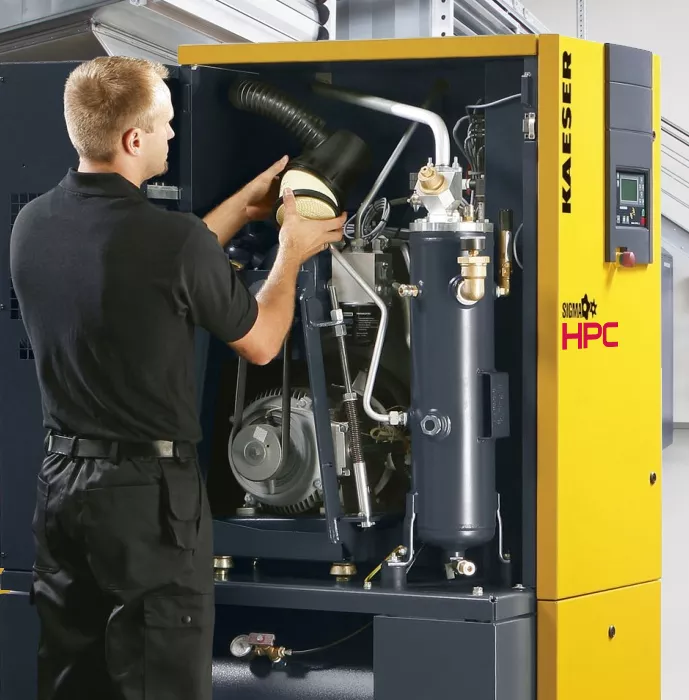
Mobile Compressed Air worked closely with the project’s engineering lead to design a system that met both performance and long-term efficiency requirements. To meet variable air demand, three KAESER rotary screw compressors were selected. These included a CSD 125 fixed-speed unit, a BSD 83 fixed-speed unit, and a CSD 105 SFC variable speed drive (VSD) unit. Together, these machines provided a combination of base load reliability and adaptive output, allowing the system to scale air delivery to match real-time site requirements. All compressors used KAESER’s energy-efficient Sigma Profile rotors. These rotors deliver up to 15 percent energy savings compared to conventional designs.
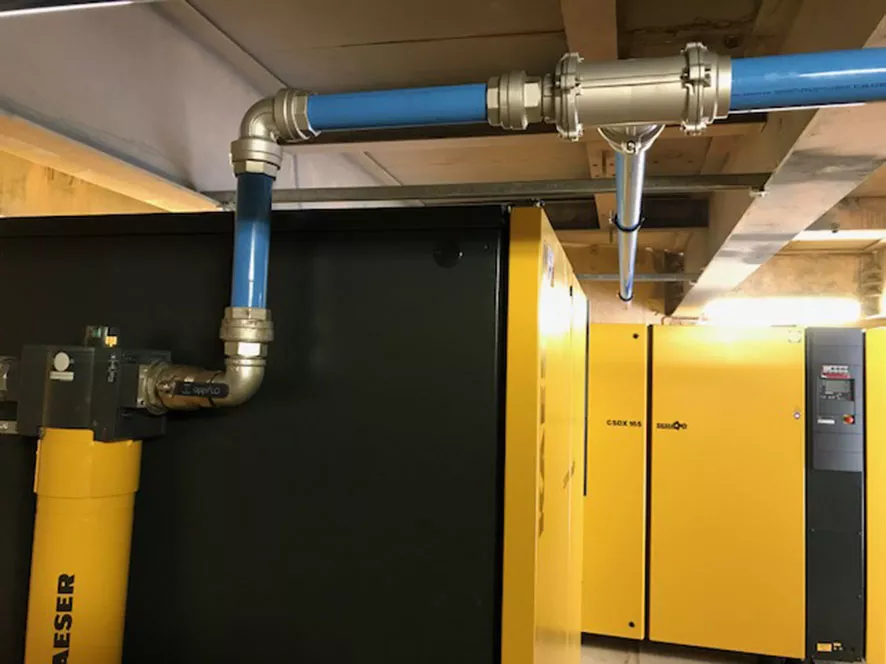
The inclusion of a VSD unit added further efficiency, automatically adjusting output based on current demand rather than fixed cycle timers. To manage these units as a single intelligent system, a KAESER Sigma Air Manager (SAM) master controller was installed. This advanced controller coordinates all compressors in the network to ensure they run in the most efficient sequence. It monitors pressure stability, load distribution, and maintenance intervals, optimising energy use and reducing total run hours. To support the full factory floor, Mobile Compressed Air also designed and fabricated custom compressed air manifolds. These manifolds, similar to a power board for air, were installed at seven locations across the site. They gave technicians easy access to clean, stable air right where it was needed — whether on the dismantling line, assembly bench, or inside the blast booth.
The Results
After the facility went live, the compressed air system operated as planned from day one. The client reported stable pressure across all applications, reliable operation of high-demand tooling, and no performance issues even during peak production times. The energy efficiency benefits were immediate. The master controller ensured only the necessary compressors ran at any given time, reducing unnecessary energy use and extending equipment life.
With the VSD unit balancing variable loads, the system avoided the high on-off cycling that typically increases power consumption and mechanical wear. The factory team gained reliable access to air across all zones, with no need for trailing hoses or ad hoc connections. This improved productivity, reduced trip risks, and made the work environment safer and more efficient. Following the success of the Adelaide installation, the manufacturer rolled out KAESER compressed air systems across four more sites nationally.
Why It Worked
The project succeeded because the solution wasn’t just about equipment — it was about matching system design to actual site needs. Mobile Compressed Air worked closely with the engineering team to size the system accurately, position air outlets for real-world use, and ensure every piece of equipment contributed to performance and efficiency. Rather than simply increasing supply to meet unknown demand, the approach focused on control, adaptability, and energy use per cubic metre of air delivered.
The inclusion of the Sigma Air Manager allowed for future system expansion without compromising efficiency. The manifolds solved a common problem for large factory floors: how to get air to every zone without sacrificing pressure or introducing safety risks. By fabricating custom hardware, MCA ensured that every part of the system was designed to serve the site — not just installed to spec.
Lessons for Other Businesses
What this manufacturer faced is typical of new-build industrial projects. The temptation is to over-specify supply to cover every possible air demand, but this often leads to poor efficiency, higher lifecycle costs, and wasted energy. This project showed that energy efficiency is not just about compressor size. It is about how demand is managed, how machines interact, and how distribution supports practical use across the floor. With rising energy costs and increasing focus on site efficiency, the benefits of intelligent compressed air management only grow over time.